
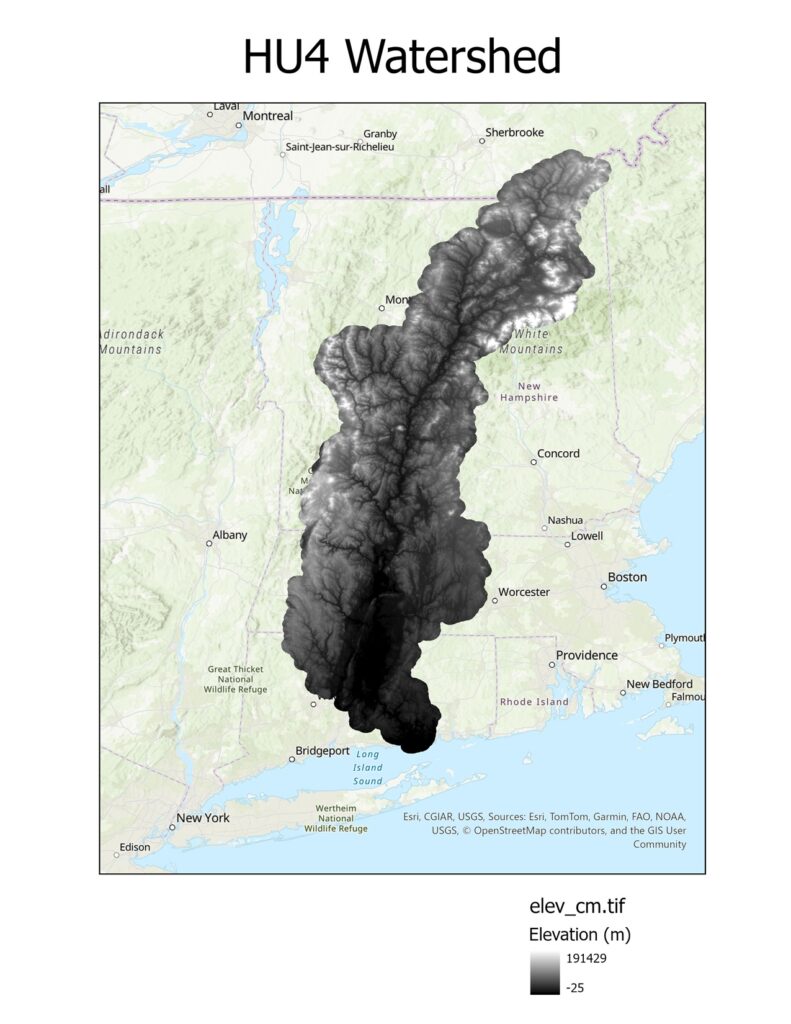
When I began this project, I knew I wanted to build a GIS model that could help identify the best areas for reforestation — not just as a technical challenge, but as a way to connect my love of forests with real-world environmental applications. One of the first decisions I had to make was where to focus.
After some consideration, I landed on the Northeastern U.S., specifically Vermont and New Hampshire.
At first glance, this might seem like an unexpected choice. These aren’t states we usually associate with large-scale deforestation or reforestation campaigns. So why here?
A Quiet but Meaningful Landscape
The forests of Vermont and New Hampshire are part of the greater Northern Appalachian-Acadian ecozone, a region rich in biodiversity and layered with a long history of land use. Much of the area was once cleared for agriculture during early settlement and has since been reclaiming itself through natural reforestation. That ongoing cycle of disturbance and recovery made it an intriguing candidate for my model.
Other reasons I chose this region include:
- Data availability: As part of the U.S., Vermont and New Hampshire have excellent access to open geospatial datasets, including land cover (NLCD), climate (WorldClim), and elevation (USGS DEMs).
- Moderate terrain: The region’s rolling hills and temperate forests are ideal for testing a reforestation model without extreme variability in slope or climate.
- Cultural alignment: These states are home to many land trusts, conservation programs, and environmentally conscious communities — all of which are relevant when considering reforestation feasibility.
A Testing Ground for the Model
While Vermont and New Hampshire may not be the areas of greatest reforestation urgency, they provided a low-risk, high-learning environment to prototype my suitability model.
Choosing this region allowed me to focus on:
- Building and debugging the Python workflow,
- Troubleshooting file formats, projections, and clipping issues,
- And developing a clear understanding of how different environmental layers interact to shape suitability.
It also helped me stay motivated. There’s something rewarding about building a map that speaks to the landscapes of New England — a region that’s forested, yes, but still full of opportunities to restore connectivity, buffer water sources, and improve biodiversity through targeted restoration.
Future Areas of Focus
Of course, I recognize that other regions may be better candidates for large-scale reforestation efforts, especially from a global conservation perspective.
In future iterations of this model, I hope to explore:
- Post-wildfire landscapes in the Western U.S. and British Columbia,
- Tropical deforestation hotspots in the Amazon, Southeast Asia, or Sub-Saharan Africa,
- Urban fringe zones where reforestation could enhance green infrastructure and climate resilience.
Each of these regions would introduce new variables — such as fire risk, human pressure, or seasonal rainfall extremes — giving me an opportunity to refine and expand the model further.
Final Thoughts
While my choice of Vermont and New Hampshire may have been rooted in accessibility and simplicity, I don’t see it as a limitation. Instead, it served as the perfect first step in a larger journey — one that blends my passion for nature with a growing curiosity for geospatial science and programming.
Sometimes, the best place to start isn’t where the need is greatest — it’s where the learning feels most meaningful.